Why Your Business Needs Retail Pricing Software Right Now
Every day your pricing lives in a spreadsheet, your margins are quietly bleeding out.
Competitors are repricing in real time. Shoppers are comparing prices across five tabs before they add anything to a cart. And your category manager is spending half their week copy-pasting data between files that nobody fully trusts.
This is not a technology problem. It’s a speed problem. And the only way to solve it is with the right pricing software — one that connects your data, automates your rules, and gives your team explainable price decisions they can act on the same day.
Here’s exactly why your business needs retail pricing software right now — and what it’s costing you to wait.
Your Pricing Cycle Is Already Too Slow
The average mid-market retailer runs a full repricing cycle every four days. In a market where competitor prices move hourly, that’s not a process — it’s a liability.
Think about what happens in four days. A competitor drops prices on your top 50 SKUs. Your buy box share drops. Conversion falls. By the time your team catches it and manually updates the pricing files, you’ve lost a week of revenue that won’t come back.
Modern pricing software closes that gap. Platforms with built-in competitor price monitoring refresh data every four hours and trigger rule-based responses automatically — no manual intervention, no four-day lag. One electronics retailer using automated pricing tools cut their competitor response time from 72 hours to under four hours, and measured 5.1% revenue growth directly attributed to that speed improvement.
Speed is margin. Every hour you reprice slower than your competitors is an hour they’re winning the sale.
Spreadsheets Are Breaking Your Team — and Your Margins
The average mid-market pricing team manages 20 or more separate pricing files across categories, channels, and regions. None of them are version-controlled. Most of them don’t agree with each other. And when a mistake gets published to your ecommerce store, nobody knows which file was the source.
This isn’t a failure of your team. It’s a failure of the infrastructure. Spreadsheets were built for analysis, not for running pricing decisions at scale across tens of thousands of SKUs in a competitive market.
Price management software consolidates all of that into a single source of truth. One workspace. One audit trail. Every price change logged with the rule that triggered it, the data that supported it, and the person who approved it. When your CFO asks why margin moved last quarter, the answer is one click away — not a three-hour investigation across a folder of Excel files.
You Are Leaving Margin on the Long Tail
Most retail teams actively manage the top 10–20% of their catalog by revenue. The rest — thousands of SKUs — are priced by inertia. Same markup applied months ago. No competitive check. No elasticity signal. Just a number that felt right at the time.
That’s where margin hides. And it’s exactly where pricing analytics software earns its place.
Price optimization software models every SKU in your catalog — not just the top sellers — and identifies where you have pricing power you’re not using, where you’re competitively exposed without knowing it, and where a small price move generates outsized margin improvement. A wine retailer that deployed this approach across 420 SKUs added 2.3 percentage points of margin uplift without changing a single product or supplier.
The long tail isn’t a graveyard. It’s an untouched margin reserve — and pricing software is how you access it.
Your Competitors Are Already Using It
Competitive pricing software is no longer a tool reserved for enterprise retailers with dedicated pricing science teams. Mid-market platforms have made dynamic pricing software and competitor monitoring accessible to retailers doing $10M to $500M in revenue — with self-serve onboarding, no IT project required, and live pricing recommendations within days of connecting your catalog.
That means the competitor who was managing pricing in the same spreadsheet chaos you are twelve months ago has likely already made the switch. They’re now monitoring your prices in real time, responding to your moves within hours, and winning margin on categories where you’re still reacting four days late.
AI pricing software has compressed the timeline for this transition dramatically. What used to take six months of enterprise implementation now takes days. The advantage window for early movers is closing — and in a margin-compressed market, being late to this shift is expensive.
The ROI Is Measurable — and Faster Than You Think
The hesitation most pricing teams have about investing in pricing tools is understandable. New software means new workflows, new data connections, and a learning curve that takes time the team doesn’t have.
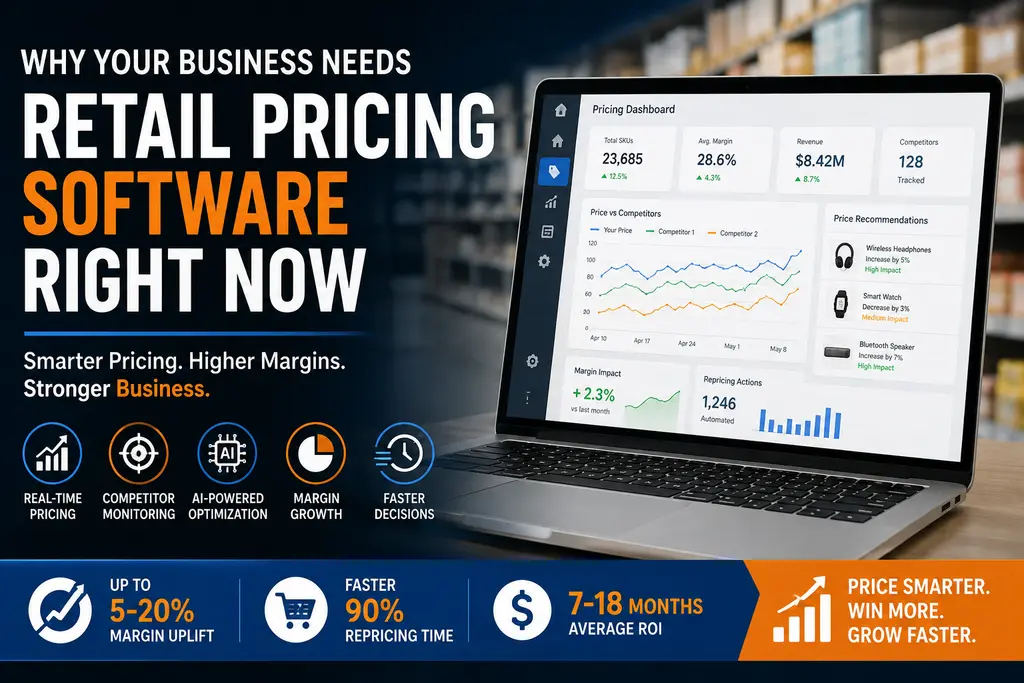
But the payback window on modern retail pricing software is 7 to 18 months from first live price — not three years. And the ROI shows up in three places simultaneously:
• Margin uplift from optimized pricing across the full catalog, including the long-tail SKUs that were previously priced by habit.
• Revenue recovery from faster competitor response — particularly on high-velocity SKUs where a four-day repricing lag translates directly to lost conversions.
• Team productivity gains from replacing 20+ manual pricing files with one automated workflow — freeing your category managers for commercial strategy instead of file maintenance.
Fashion retailers have measured 18% improvements in markdown efficiency. Electronics chains have added five points of revenue growth. Grocery teams have cut repricing time by 90%. These are not projections — they are documented outcomes from real retail teams that made the switch.
What to Look for When You Are Ready to Move
Not all retail pricing software is built for the same retailer. Before evaluating any platform, define three things: your catalog size and complexity, your team’s technical capacity, and your primary margin problem — whether that’s speed, coverage, or explainability.
The platform you choose should cover your full catalog from day one, integrate with your existing stack without a six-month project, and deliver pricing recommendations your category managers can understand, question, and approve — without a data scientist in the room.
The right retail pricing software doesn’t replace your team’s judgment. It gives your team the data, speed, and structure to act on that judgment before the market moves on.
The Bottom Line
Retail margin pressure in 2026 is real. Discounters are aggressive. Shoppers are price-sensitive. And the window for reactive, spreadsheet-driven pricing is closing fast.
The retailers winning on margin right now are not smarter than the ones losing it. They are faster. They have better data. And they have competitive pricing software that turns that data into live price decisions — not a four-day-old Excel file.
If your business is still pricing manually, the cost of waiting is not hypothetical. It’s the margin gap you’re already running, the revenue you’re already losing, and the competitor position you’re already conceding — one slow repricing cycle at a time. Switching to the right retail pricing software is one of the highest-ROI decisions a mid-market retail team can make in 2026. The only question is how much longer you wait.