
IPPT Score Calculator: The Complete Guide to Understanding Your Score
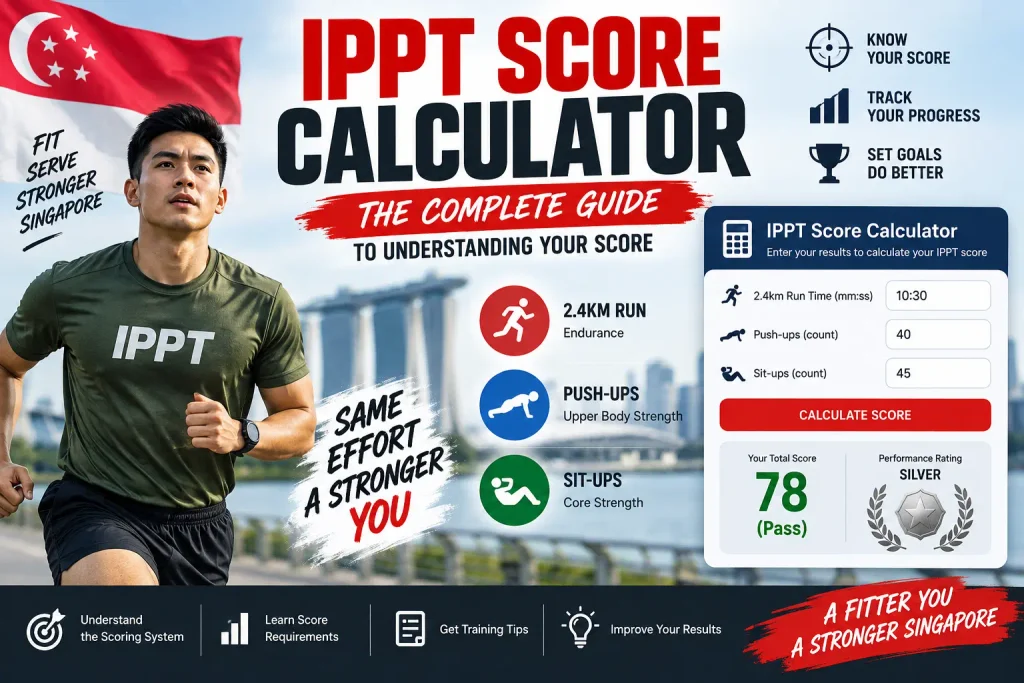
For anyone serving National Service in Singapore, the IPPT score calculator has quietly become one of the most useful tools around. Instead of flipping through pages of scoring charts or guessing how close they are to Gold, NSFs and NSmen can simply key in their numbers and see exactly where they stand. This guide walks through how the calculator works, what goes into an IPPT score, and how to make the most of the tool before test day arrives.
What Is the IPPT Score Calculator?
At its core, an IPPT calculator is a digital version of the official scoring tables used by the Singapore Armed Forces. It takes a person’s age, gender, and performance across three stations, then converts that performance into points using the same standards MINDEF applies during an actual test. Rather than cross-referencing multiple tables by hand, the calculator does the maths instantly, which makes it a handy companion for anyone preparing for their fitness test, whether they are a pre-enlistee, an NSF, or an NSman coming back for their yearly IPPT.
How IPPT Scoring Works
The IPPT is made up of three stations, and together they add up to a maximum of 100 points. Each station contributes a share of that total:
- Push-ups – worth up to 25 points
- Sit-ups – worth up to 25 points
- 2.4km run – worth up to 50 points
Because the run carries the heaviest weight, it often makes the biggest difference to the final score. Scoring is not one-size-fits-all, though — it is adjusted by age and gender, so a 45-year-old and a 22-year-old are held to very different benchmarks for the same number of points. This age-based structure is exactly why a calculator is so much easier than trying to memorise a chart.
Breaking Down the Three IPPT Stations
Push-Ups
Participants have one minute to complete as many proper push-ups as they can. Only full, correctly executed repetitions count, so form matters just as much as speed. Someone consistently getting “no-counts” despite putting in the reps usually has a technique issue worth ironing out before test day.
Sit-Ups
Sit-ups follow the same one-minute format, testing core strength and muscular endurance. Most age groups need somewhere in the range of 30 to 35 clean reps to pass this station, with Silver or Gold typically requiring 45 or more, depending on age.
2.4km Run
The run is the largest single contributor to the overall score, and timing is everything here. A faster finish translates directly into more points, and because the run is weighted so heavily, even small improvements in pace can shift someone from Pass to Silver, or Silver to Gold.
Age Groups and Why They Matter
IPPT scoring is split into a series of age bands, with each band carrying its own set of thresholds. Broadly, IPPT age groups run from below 22 all the way up to 60, with each bracket becoming a little more lenient than the one before it. A participant in an older age group needs fewer push-ups, fewer sit-ups, or a slower run time to earn the same number of points as someone younger. This is designed to keep the test fair as fitness naturally changes with age, and it’s also the main reason two people with different birth years can post very different raw numbers yet land on the exact same score.
Award Categories and Incentives
Once the three stations are added up, the total score determines which award category a person falls into:
- Fail – below 51 points, or zero points in any single station
- Pass – 51 to 60 points
- Pass with Incentive – 61 to 74 points
- Silver – 75 to 84 points
- Gold – 85 points and above
Passing comes with more than just a certificate. NSmen who clear the test within their window are typically eligible for a cash incentive, with the amount rising as the award tier goes up. This is one of the biggest reasons people use a calculator ahead of time — knowing the gap between a current score and the next award band makes it much easier to decide where training time is best spent.
Understanding the NSman Lifecycle
The IPPT doesn’t exist in isolation — it’s one part of a much longer journey that every NSman goes through after completing full-time National Service. Once someone reaches their Operationally Ready Date (ORD), they move into Operationally Ready National Service (ORNS), and this is where the NSman lifecycle really begins.
Over roughly a 10-year cycle, this stage typically includes annual In-Camp Training (ICT), yearly IPPT windows, and periodic check-ins on operational readiness. A few things are worth understanding along the way:
- The IPPT window follows the birthday, not the calendar year. Each NSman’s annual fitness obligation opens on his birthday and closes the day before the next one, so tracking that personal window matters more than tracking the calendar.
- High Key versus Low Key ICTs. Some in-camp training years are longer and more intensive (often called High Key), typically falling in the middle years of the cycle, while others are shorter Low Key call-ups. Knowing which type of year is coming up helps with planning training time around it.
- NS FIT as a safety net, not a punishment. Anyone who doesn’t clear the passing mark isn’t simply marked as a failure — they’re routed into the NS FIT programme instead. This involves a set number of guided sessions (workouts such as HIIT, strength training, or circuit training) designed to build fitness gradually, and completing the programme still clears the year’s requirement.
- The finish line: MINDEF Reserve (MR). Once an NSman completes his full cycle of ICTs — generally by age 40 for warrant officers, specialists, and enlistees, or age 50 for officers — he moves into MR status. From that point, annual IPPT and ICT call-ups come to an end.
Looking at the NSman lifecycle as a whole, rather than just the next test date, makes it much easier to pace training sensibly. Someone who understands roughly which years will be more demanding can plan ahead instead of scrambling before every fitness window, and the IPPT score calculator becomes a useful checkpoint at each stage of that longer journey.
How to Use the Calculator: A Simple Walkthrough
Using the tool is refreshingly straightforward, and most versions follow a similar flow:
- Select gender – scoring tables differ slightly here due to physiological differences.
- Enter age – this determines which age band the scoring will follow.
- Input push-up reps completed within the one-minute window.
- Input sit-up reps from the same one-minute format.
- Enter the 2.4km run time in minutes and seconds.
- Hit calculate to see the total score, award tier, and cash incentive instantly.
The result usually shows a breakdown by station, which makes it easy to spot the weakest link. If push-ups are dragging the score down while the run is strong, that’s a clear signal on where to focus.
Tips to Improve an IPPT Score
- Train the run first. Since it carries up to 50 points, shaving even 30 seconds off a run time often adds more points than extra reps elsewhere.
- Practise push-ups and sit-ups in sets. Three one-minute sets with short rest breaks build the rhythm and endurance needed to avoid slowing down near the end.
- Check form regularly. No-counts are one of the most common reasons scores fall short of expectations, so a training buddy or coach can help catch technique issues early.
- Retest with the calculator often. Plugging in updated numbers every few weeks is a simple way to track progress and stay motivated.
- Know the target, not just the pass mark. Aiming a little above the Silver or Gold line builds a buffer in case of an off day.
Frequently Asked Questions
What is a passing IPPT score? A total of 51 to 60 points, with at least 1 point scored in each station, counts as a pass. Scoring zero in any one station results in an automatic fail, regardless of the total.
Do IPPT calculators give the exact official score? Most tools are built closely around the official scoring tables and are accurate for standard tests. However, anyone exempted from a station should rely on the official scoring system rather than a general calculator, since exemptions change how the total is worked out.
Does age really make that much difference? Yes. Because the test uses age-adjusted thresholds, the same score can come from very different raw numbers depending on which age band someone falls into.
Final Thoughts
An IPPT score calculator won’t do the training for anyone, but it takes the guesswork out of preparation. By showing exactly how many points each station is worth and how far off the next award band is, it turns a vague goal like “get fitter” into a concrete target. Whether the aim is simply to pass or to chase that Gold incentive, checking progress against the calculator regularly is one of the easiest ways to train with purpose instead of hoping for the best on test day.